BbsI inclusion body purification: working protocols?

Hi All,

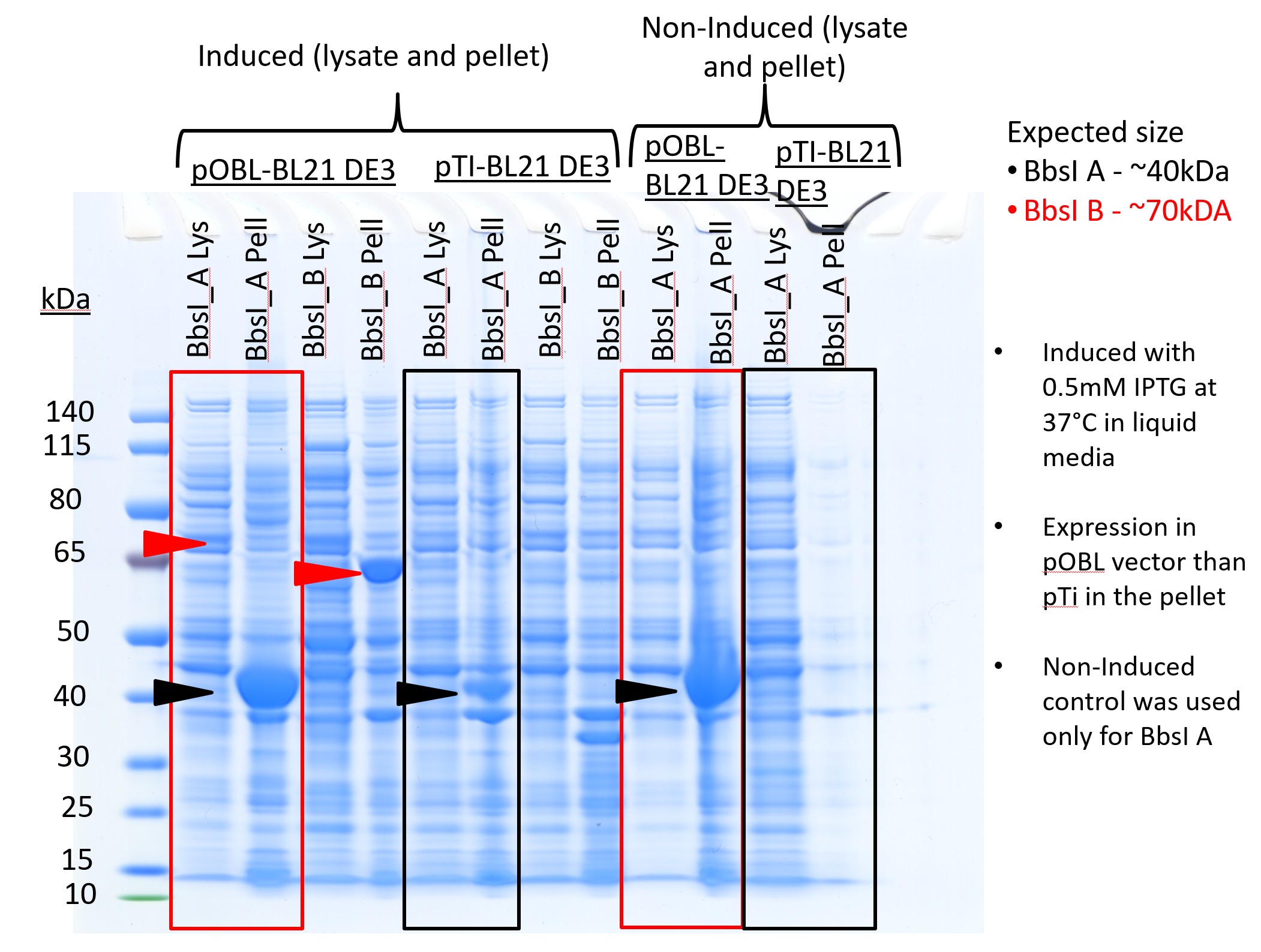
We are working on BbsI enzyme expression and purification in @jenny_molloy’s lab; where we tried pOBL and pTI backbones for cloning and BL21 (DE3) and BL21 (DE3) pLysS strains for expression. pOBL_BL21 (DE3) expressed the enzyme well, however, it is as inclusion body (in the pellet). Does anyone have good working protocols for inclusion body purification? Here is the SDS PAGE.

I had a chat about this with @MarkoHyvonen and he recommended avoiding dialysis and starting with a dilution-based refolding because it is simpler, although you do need to concentrate afterwards.

He suggested to try a range of buffers/pH/additives and test what works by using a thermal shift assay. If the TSA shows unfolding at the expected temperature then the protein must have refolded.

@MarkoHyvonen you mentioned there are a couple of papers with more information?

I found this one:
https://www.nature.com/articles/s41598-017-09687-z
Wang, Y., et al. A systematic protein refolding screen method using the DGR approach reveals that time and secondary TSA are essential variables. Sci Rep. 2017; 7 (1): 9355. Epub 2017/08/24. doi: 10.1038/s41598-017-09687-z. PubMed PMID: 28839267.

Refolding of proteins derived from inclusion bodies is very promising as it can provide a reliable source of target proteins of high purity. However, inclusion body-based protein production is often limited by the lack of techniques for the detection of correctly refolded protein. Thus, the selection of the refolding conditions is mostly achieved using trial and error approaches and is thus a time-consuming process. In this study, we use the latest developments in the differential scanning fluorimetry guided refolding approach as an analytical method to detect correctly refolded protein. We describe a systematic buffer screen that contains a 96-well primary pH-refolding screen in conjunction with a secondary additive screen. Our research demonstrates that this approach could be applied for determining refolding conditions for several proteins. In addition, it revealed which “helper” molecules, such as arginine and additives are essential. Four different proteins: HA-RBD, MDM2, IL-17A and PD-L1 were used to validate our refolding approach. Our systematic protocol evaluates the impact of the “helper” molecules, the pH, buffer system and time on the protein refolding process in a high-throughput fashion. Finally, we demonstrate that refolding time and a secondary thermal shift assay buffer screen are critical factors for improving refolding efficiency.


Anyone tried on-column folding?

The Structural Genomics Consortium also published this protocol for on-column chemical refolding - anyone had any experience with this?

The advantages of on-column chemical refolding include lack of dependence upon protein concentration, high yields of soluble protein, simultaneous purification and refolding and amenability to high-throughput refolding.

Also a quick thought - maybe we should try refolding the two BbsI subunits together in the same tube, if we can find compatible conditions?

The open reading frames are overlapping in the source genome, so probably there is translational coupling and they are not very stable on their own.

We’re only expressing them separately so they aren’t able to restrict DNA until we combine them and we don’t need to co-express methyltransferase.

Jenny

Hi Birhan!

I did an inclusion body purificaiton for the metalloprotein I was working with and it worked really well! Since it needed an oxidative environment, I had to use GSH/GSSG. I have tried Ni-NTA purification after denaturing from inclusion bodies using 8M Urea or 6M GnCl. I used the protocol for denaturing purificaiton from this handbook https://share.google/I09xI8gfFsB6jc1HE page 20.

And then the refolding protocol here:
Here is the concise, step-by-step redox refolding schedule:


Redox Refolding Protocol

  • Step 1: Initial Solubilization
    • Buffer: 25 mM Tris-HCl (pH 8.0), 300 mM NaCl
    • Additives: 3.0 M Urea, 0.25 M L-Arginine
    • Conditions: 4°C for 12–16 h
  • Step 2: Start Redox Mediated Formation
    • Buffer: 25 mM Tris-HCl (pH 8.0), 300 mM NaCl
    • Additives: 2.0 M Urea, 0.25 M L-Arginine, 10 mM GSH / 1 mM GSSG
    • Conditions: 4°C for 12–16 h
  • Step 3: Continued Refolding
    • Buffer: 25 mM Tris-HCl (pH 8.0), 300 mM NaCl
    • Additives: 1.0 M Urea, 10 mM GSH / 1 mM GSSG
    • Conditions: 4°C for 12–16 h
  • Step 4: Gradual Urea Removal
    • Buffer: 25 mM Tris-HCl (pH 8.0), 300 mM NaCl
    • Additives: 0.5 M Urea, 10 mM GSH / 1 mM GSSG
    • Conditions: 4°C for 12–16 h
  • Step 5: Final Stabilization
    • Buffer: 50 mM Sodium Acetate (pH 6.0), 150 mM NaCl
    • Additives: None (0.0 M Urea)
    • Conditions: 4°C for 12–16 h

We have also in the past used 0.5M L-Arg to extract protein from inclusion bodies and buffer exchange it to PBS (instead of refolding) and then do a regular Ni-NTA purification

Thanks a lot @av600! I will try the protocol.

Yes, we tend to do just dilution refolding as it is more scalable and generally more controllable compared to dialysis. You can do small scale refolding in 1 ml volumes in eppies or deep well block and scale that to liters with same protocol.

Key to all refolding is to minimise aggregation – prevent your unfolded protein from meeting another unfolded protein (or more) and tangling into a mess that never becomes a functional protein. That being concentration dependent, protein concentration needs to be low. How low, depends on the protein and how fast it refolds. Another reason (in addition to NOT needing dialysis tubing) for dilution refolding is ability to control protein concentration freely. People tend to do dialysis refolding at very high protein concentration, leading easily (but not always, before some tells me they do this!) in massive milk-like precipitation

Most proteins refold independently of others and inclusion bodies being already relatively pure, I have never see purification of the denatured protein to improve the yield. Just denature and refold.

Using those additives listed in the abstract below as well is usually needed to prevent aggregation and therefore not getting that visible precipitation is not a good indicator of successful refolding as the additives tend to keep aggregates soluble as well (or don’t let massive aggregates to form). The idea of using thermal shift for evaluating success is that you should only get a denaturation curve if you have folded protein. It is fast and uses little sample. But you need the dye (SyproOrange usually) and qPCR machine. Note that while thermal shift is used normally to look at melting temperature of the protein, that is of less interest here as you will be screening lots (96?) conditions with different pH, salt, …. And all those affect Tm. What is more interesting, given a decent curve, is the height of the transition in melting as that should correlate with amount of folded protein. If you have a ligand, repeat with that – it should show shift for proteins that are really folded.

Back to original question on inclusion body (IB) prep: spin, wash, spin, wash, spin, wash, solubilise, spin.

You want detergent wash to remove lipids (1% triton-X100, zwittergent 14,…)

You want high salt wash to remove nucleic acids (1 M NaCl, but even higher if basic proteins, like DNA binding ones)

Final wash to remove the rest of crap.

IBs are heavy as ever, not need for long hard spins, apart from the first perhaps (lipids kind of float on top of the IB pellet and you can scrape them off). Use short gentle spins. Resuspend the pellet completely to fine emulsion in the washes. Hand held homogenisers are great, sonicator works well. Small scale: pipette up and down vigorously).

For solubilisation, resuspend the pellet in ? of solubilisation volume in water or buffer. Then add the denaturant. Don’t dissolve the solid pellet directly, takes for ever and life is too short for it. If you have cysteines (usually you do), have reducing agent in solubilisation, even in washes if plenty of cysteines. TCEP best, DTT next, b-merc last. Make the two last fresh before use as they oxidise readily and lose their power. Here is an old (25 years!) protocol for large scale prep, just scale down for your volumes:

https://hyvonen.bioc.cam.ac.uk/wp-content/uploads/2017/09/ib.pdf

Rule of thumb for starting the refolding and assuming well expressed protein: refold in the same volume as original bacterial culture. Then scale protein concentration up and down. 100 ml culture gives you then 100 X 1 ml refolding trials, ie. 96-well plate of conditions.

Some stuff on this and plenty more on slides from the course I run for postgraduate at USP S?o Paulo, slide 242 onwards:

https://hyvonen.bioc.cam.ac.uk/wp-content/uploads/2025/11/Protein_production_USP_20251104.pdf

happy refolding and keep those aggregates at bay, Marko

~WRD0504.jpg

Thank you so much @MarkoHyvonen for the detailed information. This helps a lot! And I will keep you updated on my progress.

Hi Everyone,

Thanks everyone for your recommendations on inclusion body purification. @MarkoHyvonen the paper and presentation helped me a lot to draft a protocol (https://icgeborg.sharepoint.com/:w:/s/BiomanufacturingGroup2/IQDG9PwLm5asQ5qzUL0njTC2AfG8qdZ-7hpmUEtZWmb2dH4?e=nwCB8T. We would be grateful to have feedbacks or comments on the proposed approach before we dive into the real experiment, specially the refolding section of the protocol.

Birhan