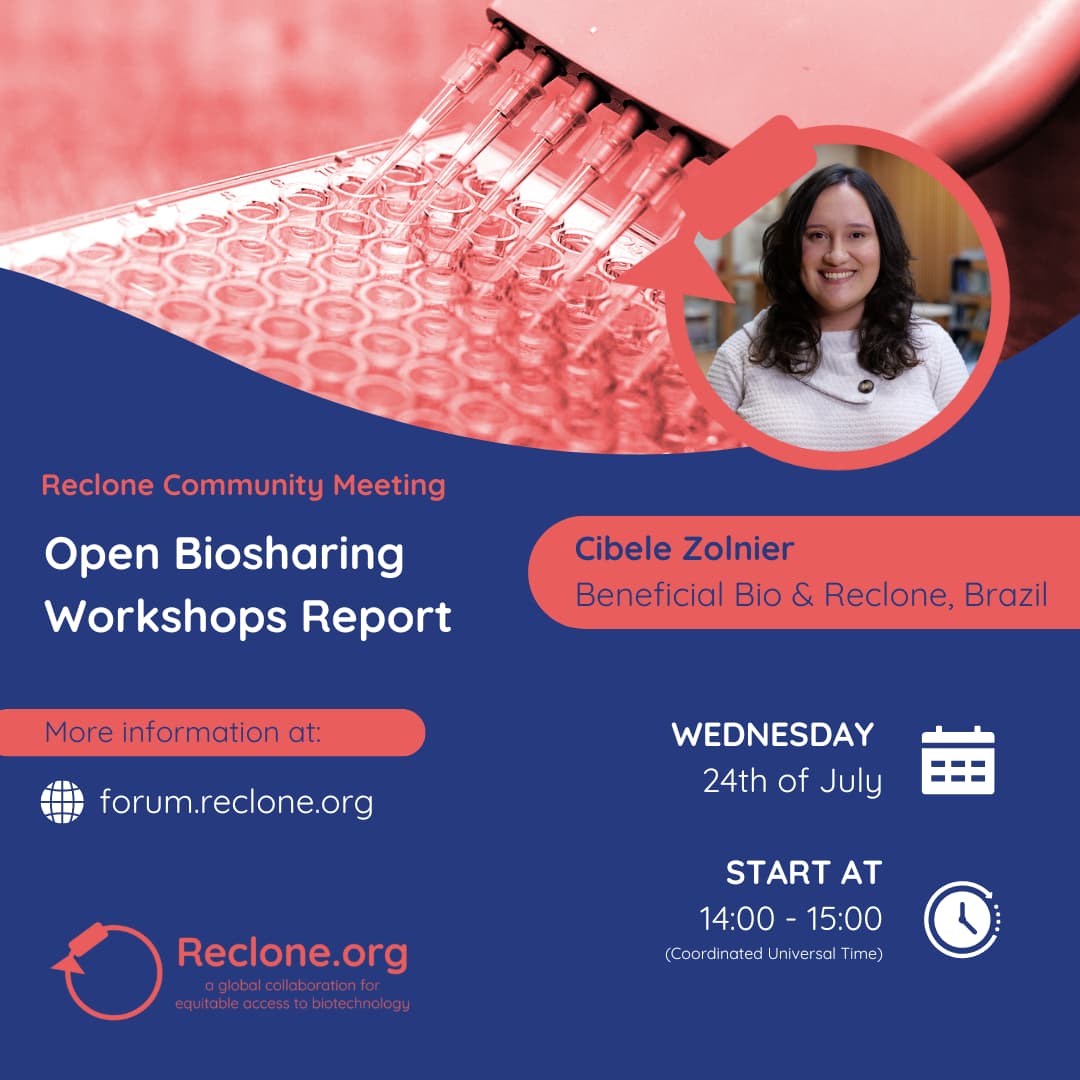
You’re all invited to our Community Meeting on 2024-07-24T14:00:00Z. I will be presenting the Report from the Open Biosharing Workshops:
The Open BioSharing Workshop Series, promoted by Beneficial Bio and Reclone.org, gathered leaders working to develop and distribute open biological materials and resources, who are committed to advancing open biosharing practices, responsibly and ethically. In this session, we will share some of the key learnings and outcomes of these Workshops!
In the meantime, you can get a sneak-peak into the preliminary discussions from the workshops by joining us at the Community Meeting today - all details are in the first post
No inconvenience at all - we recorded the meeting and will upload it in due course!
(Also apologies that we’ve been a bit late with updating with summaries and recordings of the meetings - we’ve been trying to update a lot of things in the background for a while and didn’t have the time/resources to get these up in a timely manner. We’ll get to them soon!)
Today was a very good session both with @cibele at the helm and with great discussion from the members on call. We’ll post again when we have the final report ready for sharing!
In the meantime, we welcome the community to post in this thread about any other challenges/barriers that they’ve faced when trying to share and/or receive bio-materials, and if they found ways to resolve these issues!
The more we can share about the problems and the solutions, the more we can find better ways to improve and make open biosharing fairer and easier for all!
Hi all. Just to follow up on yesterday’s meeting, I submitted a data request at work to get that list of countries that get plasmids in the following formats: bacterial stabs, DNA in liquid, DNA on filter paper. A relatively small number of countries get plasmids in the second two formats because, over the years, we have determined that getting transformed bacteria through customs is not viable. When I get these lists back from our Data team, I will share it here.
Though it was more than a year ago, we extend our thanks once more for joining us for Cibele Zolnier’s (@cibele) inspiring talk! She shared valuable insights on “Open BioSharing Workshops” on behalf of Beneficial Bio and Reclone.org.
Here are some highlights from the discussion for those who may have missed it:
The workshops brought together leaders to promote the ethical and responsible sharing of biological materials (such as DNA, cells, and strains), drawing on principles like access, attribution, reuse, redistribution, and non-discrimination, aligned with UNESCO’s open science recommendations and FAIR principles.
Success stories highlighted include the Open COVID Pledge, FreeGenes Project distributing open-source DNA to over 500 researchers in more than 50 countries, and the OpenMTA as an improved alternative to traditional material transfer agreements.
Key challenges discussed involve regulatory gaps for genetically modified organisms, complex MTAs unsuitable for non-academic settings, shipping delays, customs issues, high costs, and the need for better support for researchers in the Global South.
You can check the complete session on our YouTube: Link

 Join us via Zoom: Launch Meeting - Zoom



 Reclone Community Meeting Recap
 The workshops brought together leaders to promote the ethical and responsible sharing of biological materials (such as DNA, cells, and strains), drawing on principles like access, attribution, reuse, redistribution, and non-discrimination, aligned with UNESCO’s open science recommendations and FAIR principles.