Hi All
I put a proposal on github to convert pTi (the Reclone expression backbone - forum post | github ) into a pET-DUET-style dual expression vector with two independent CD-overhang cloning sites for sequential CDS assembly.
opened 12:40PM - 16 Jun 26 UTC
wetlab
## Proposal
Convert pTi into a pET-DUET-style dual expression vector with two in… dependent CD-overhang cloning sites for sequential CDS assembly
## Overall Aim
Create a version of pTi that supports dual, independent expression of two coding sequences (CDS) from separate T7 promoters within a single vector, analogous to the commercial pETDUET-1 system. Both cloning sites must be compatible with the Reclone CD-overhang syntax so parts can be added sequentially from the standard Reclone collection without custom primer design.
## Background
pETDUET-1 is a bacterial expression vector designed for the co-expression of two recombinant proteins from a single plasmid in E. coli hosts carrying the T7 RNA polymerase gene (typically BL21(DE3) strains). It carries two independent expression cassettes, each comprising a T7 promoter, a ribosome binding site, a multiple cloning site (MCS), and a T7 terminator, arranged in tandem on the same plasmid backbone. Each MCS is also preceded by an optional His-tag sequence, allowing affinity purification of either or both proteins. The vector uses a ColE1 origin of replication and ampicillin resistance, making it compatible with other Duet vectors (which carry different origins and markers) for multi-plasmid co-expression of up to eight proteins simultaneously.
The key design principle is that each cassette is transcriptionally independent — induction with IPTG drives T7 polymerase to transcribe both inserts, but the two T7 terminators ensure the transcripts are discrete rather than read-through. This makes pETDUET-1 particularly useful for assembling multi-subunit complexes, enzyme–chaperone pairs, or pathway modules where the stoichiometry and co-translational folding of two proteins matters. The trade-off is that expression levels from the two sites are not individually tuneable beyond choice of insert sequence, and the relatively high copy number of the ColE1 origin means metabolic burden can be significant when both sites carry large inserts.
---
## Motivation for a pTi version
pTi is the workhorse T7-expression backbone in the Reclone collection. Many co-expression experiments currently require two separate vectors and two selection markers, complicating strain construction and plasmid maintenance. A dual-site pTi would allow single-vector co-expression, reduce metabolic burden from a second origin/marker, and remain fully compatible with the existing Reclone parts syntax, lowering the barrier for combinatorial pathway work.
---
## Specific Objectives
1. Insert a second T7 promoter + RBS + MCS-equivalent + T7 terminator cassette into pTi at a defined, non-disruptive genomic locus.
2. Assign distinct CD overhangs to Site 1 and Site 2 so that Golden Gate assembly can load each site independently (and sequentially) without cross-reactivity.
3. Validate that both sites support comparable expression levels to single-site pTi.
4. Deposit the new backbone and all associated parts in the Reclone registry with fully annotated GenBank/SnapGene files.
---
## Design Constraints
| Constraint | Requirement |
|---|---|
| Compatibility | Must use standard Reclone CD-overhang set (no novel overhangs unless justified) |
| Assembly chemistry | Golden Gate (BsaI-HF v2 or equivalent Type IIS enzyme used by Reclone) |
| Host | *E. coli* BL21(DE3) as primary host; design should not preclude other DE3 strains |
| Marker | Retain single existing antibiotic resistance marker from pTi; do not add a second marker |
| Insert capacity | Each site must accommodate CDS up to at least 3 kb |
| Overhang orthogonality | Site 1 and Site 2 overhangs must be verified orthogonal (≥2 bp mismatch from each other and from all existing Reclone overhangs) |
| Regulatory elements | Each site requires its own T7 promoter, RBS (ideally from existing Reclone RBS parts), and T7 terminator |
| Sequence | Full annotated sequence deposited before closure |
---
## Proposed Strategy
### 1. Backbone design
- Use existing insertion site in AF_pTi
- Design Site 2 cassette: T7 promoter → CD_Site2_upstream_4nt → stuffer fragment → CD_Site2_downstream_4nt → T7 terminator.
- Select CD overhangs for Site 2 by running the Reclone overhang orthogonality checker against the existing set; document chosen overhangs in the issue.
-
### 2. Vector construction
- Synthesise cassette with homology arms for Gibson assembly into linearised pTi.
- Transform, colony PCR three independent colonies across the full insert.
- Send for whole plasmid sequencing
### 3. Functional validation
- **Expression test:** Clone eGFP into Site 1, mCherry into Site 2 (using existing Reclone fluorescent protein parts if available).
- **Sequential assembly test:** Assemble Site 1 first → verify → then assemble Site 2 to confirm independent loading.
- **Quantification:** Measure fluorescence and run SDS-PAGE / western to confirm dual expression. Compare band intensity to single-site pTi controls.
-
### 4. Orthogonality confirmation
- Cross-assemble: attempt loading a Site 2 part into Site 1 reaction and vice versa. Confirm zero or near-zero background colonies carry the wrong insert.
---
## Outputs (to be deposited in Reclone Google Drive)
- [ ] Annotated GenBank file for pTi-DUO (new backbone)
- [ ] Primer and de novo synthesised sequences used for construction (CSV or table in issue)
- [ ] Sequencing data / trace files
- [ ] Validation gel images and/or fluorescence data (linked in issue comments)
- [ ] Short build note summarising any deviations from the proposed strategy
- [ ] Reclone vector datasheet for pTi-DUO
---
## Risks & Mitigations
| Risk | Likelihood | Mitigation |
|---|---|---|
| Stuffer fragment leaks into final construct | Medium | Add negative selection (ccdB stuffer) or verify by blue/white if possible |
| Second cassette reduces transformation efficiency | Low | Optimise ligation ratio; use electrocompetent cells |
| Cross-reactivity between Site 1 and Site 2 overhangs | Low-Medium | Run in silico orthogonality check before ordering any oligos |
| Second cassette causes instability in *E. coli* | Low | Screen multiple clones; check growth rate vs pTi parent |
---
## References
- [Reclone syntax specification](https://docs.google.com/spreadsheets/d/1uUS6TaIy0YuT8W7hdeonu0NSpAHinieyPcvgZRG1Nos/edit?gid=807017147#gid=807017147)
- [pET-DUET Manual](https://github.com/user-attachments/files/29001492/71146-001.pdf)
- [pTi Data Sheet](https://docs.google.com/document/d/1lQLmJkk3xpBLPb4ZxkNZoQ9o6vND8bfY/edit)
@Daniel_C_A is picking up this project and will post designs and updates here - feedback welcome!
Jenny
Thanks, Jenny.
I’m considering three possible strategies for creating a pETDuet-style dropout vector, and I’d appreciate your thoughts on which approach would work best in the Reclone context.
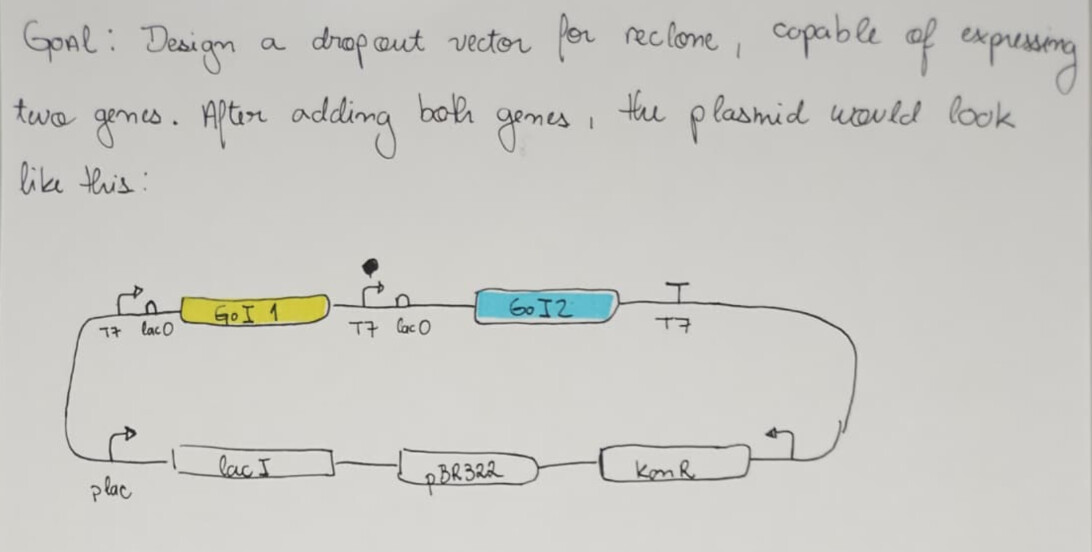
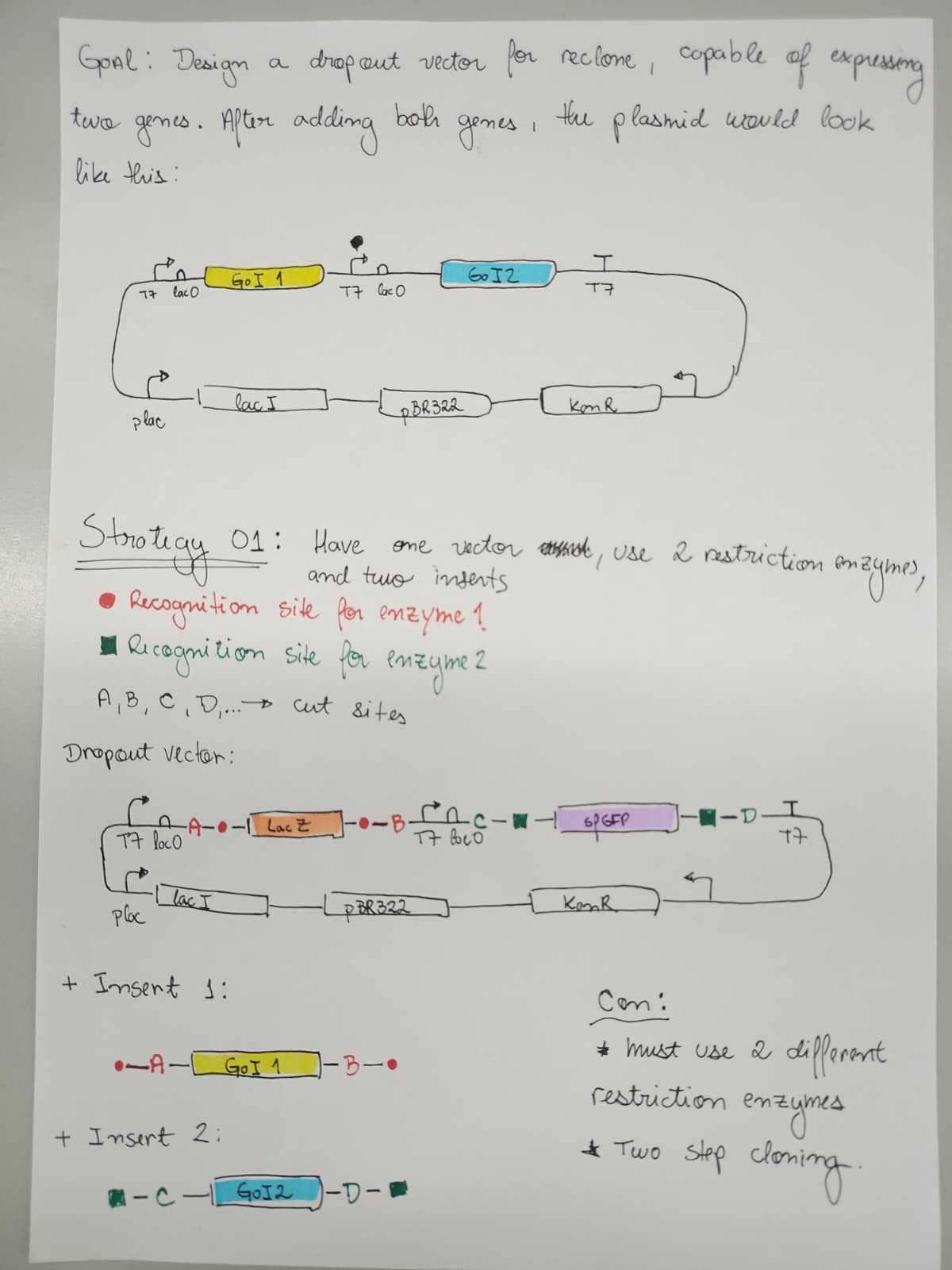
Here is a sketch of the intended end goal:
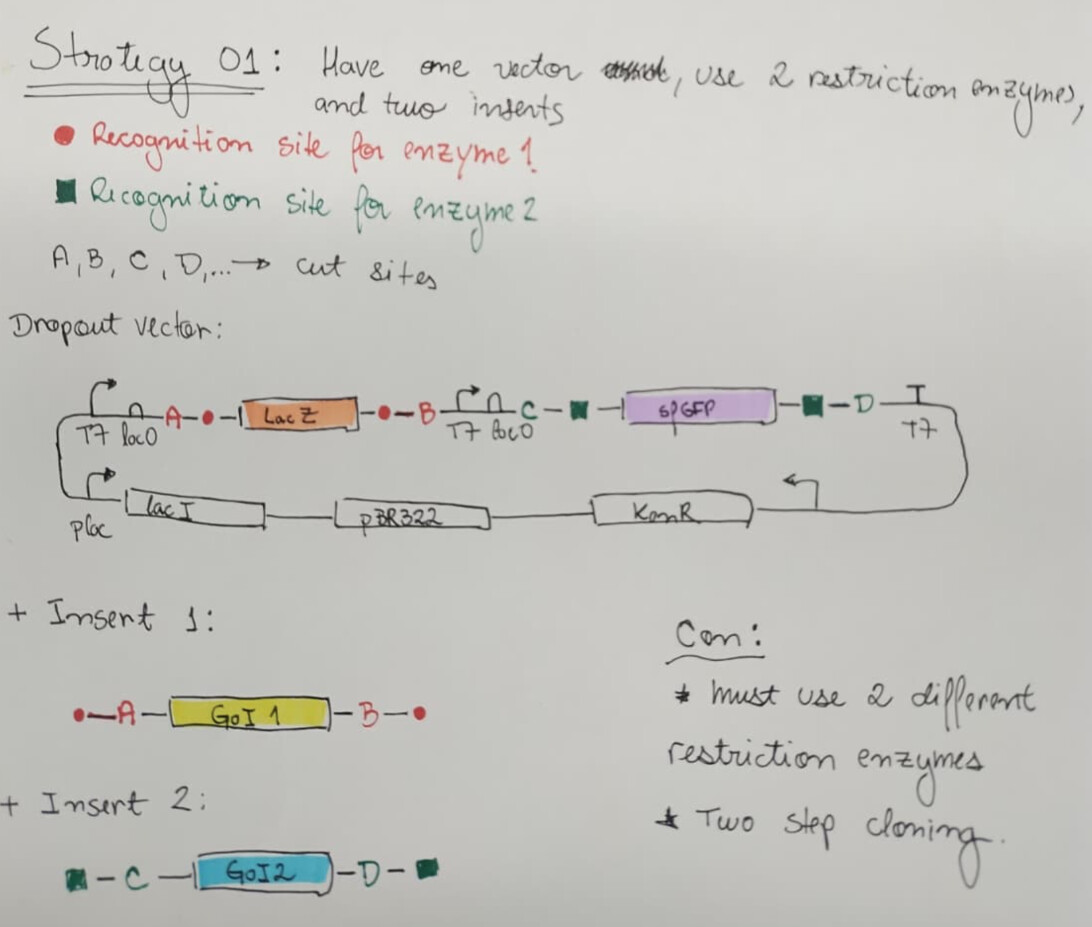
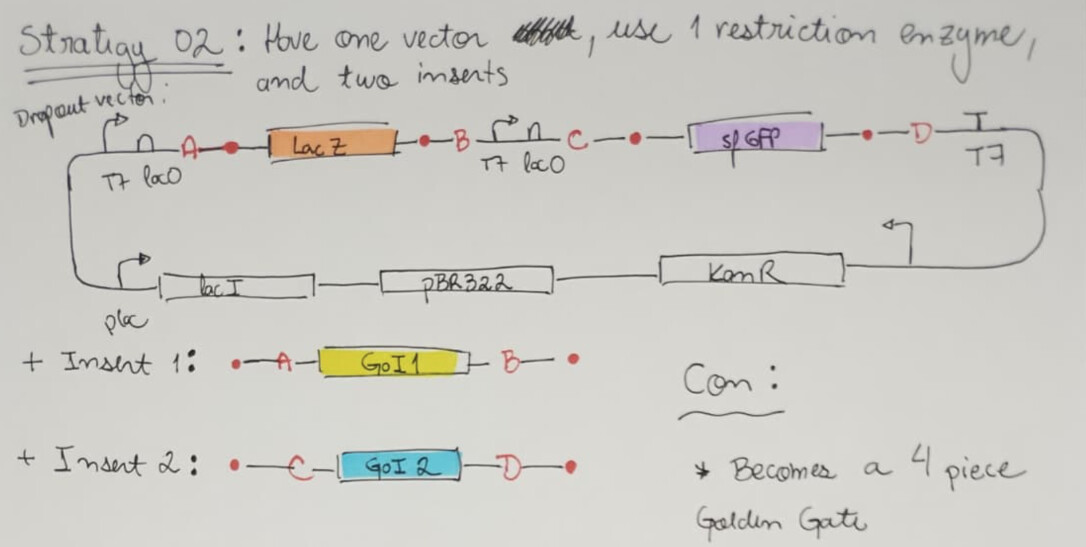
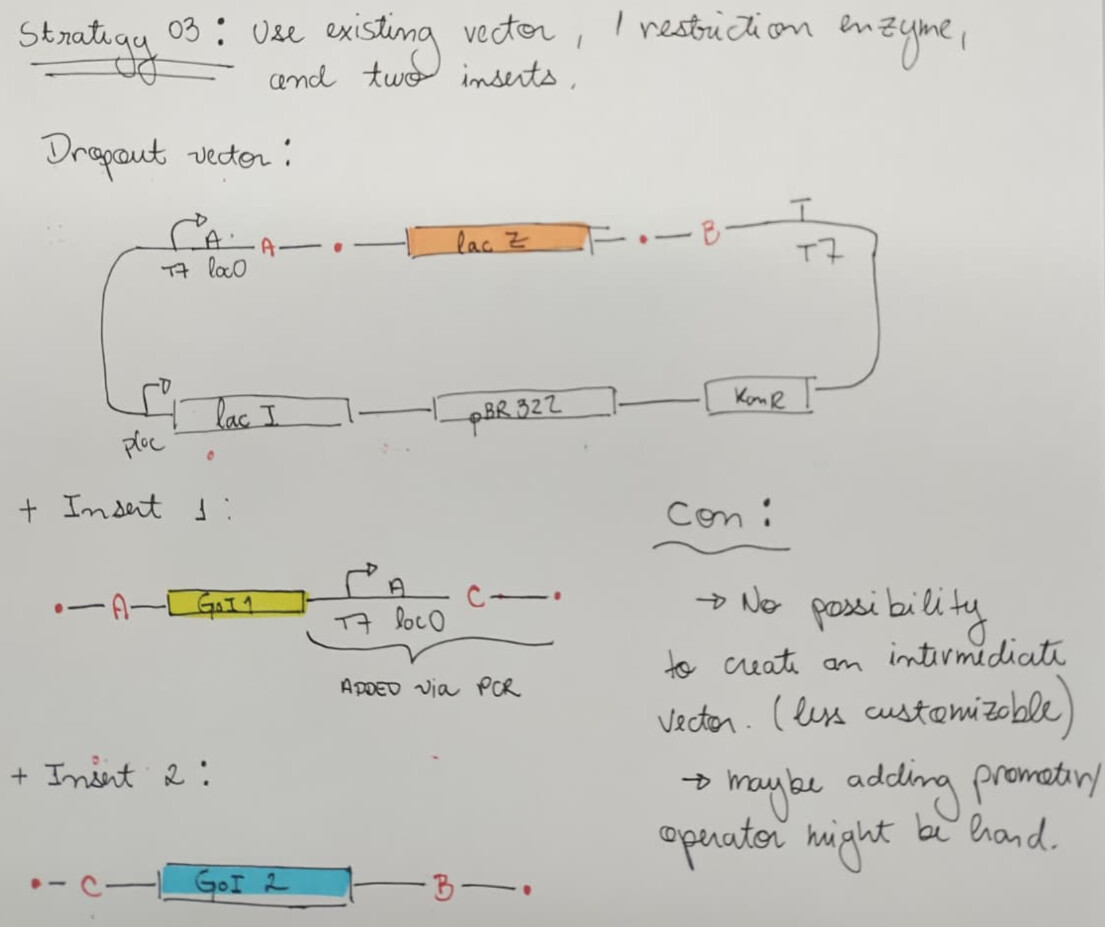
Below are the three strategies I’m considering. (Images will come after and the forum only allow new members to post 1 image per post)
Strategy 1 Create a dropout vector that requires two different restriction enzymes to insert the two expression genes. This approach is the most modular and is the least likely to encounter assembly issues. However, it requires using two different Type IIS restriction enzymes.
Strategy 2 Create a dropout vector that requires only one restriction enzyme to insert both expression genes. This allows for a one-pot assembly but results in a four-piece Golden Gate reaction, which may be less efficient and more prone to assembly issues.
Strategy 3 Use the same dropout vector design as the existing pTi construct, with a single restriction enzyme. In this approach, the two inserts are ligated together before insertion and include the promoter/operator sequence between them.
Let me know what you believe is the best approach for the Reclone context