Hello Reclone Community 
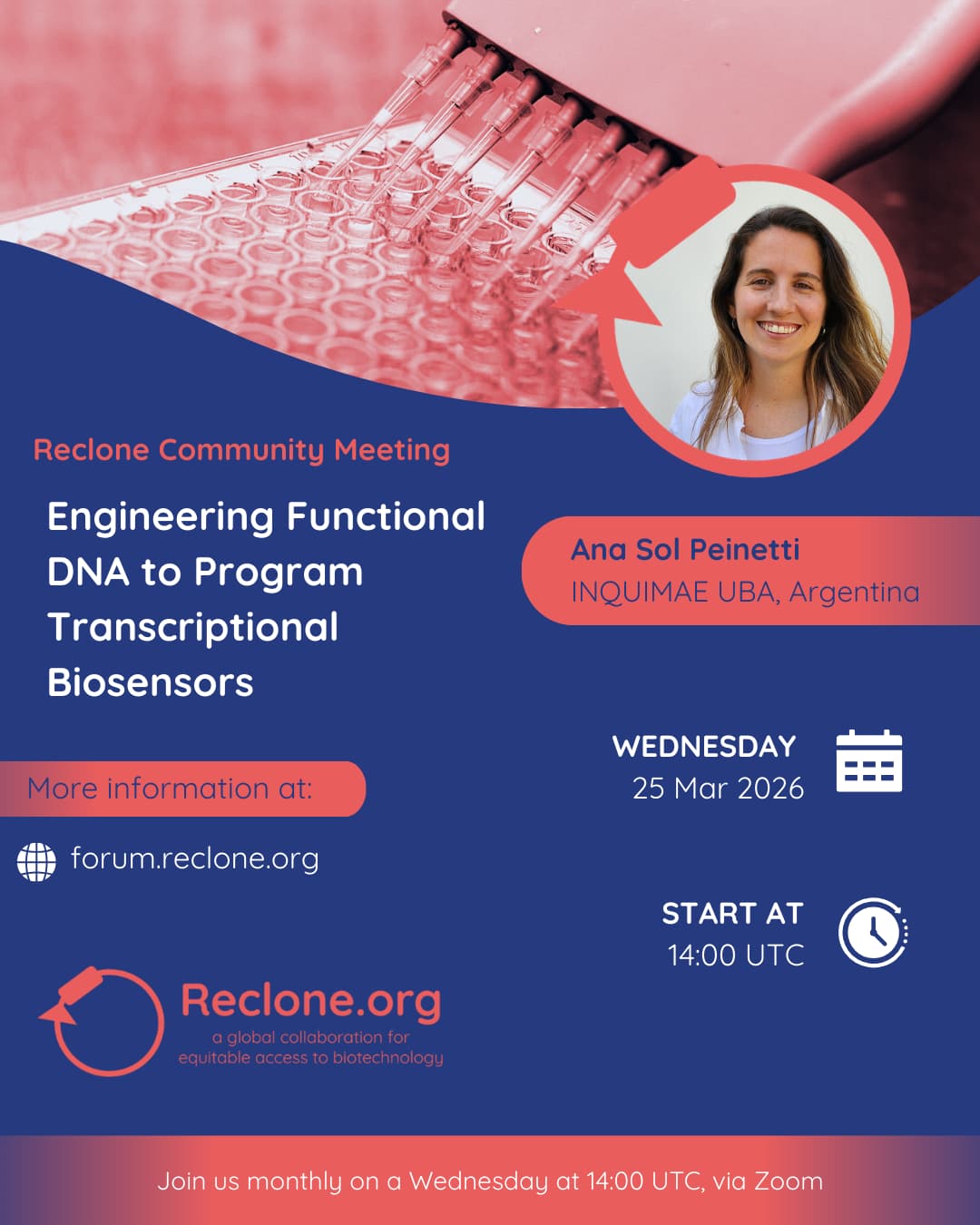
You’re all invited to our Community Meeting next week, on 2026-03-25T14:00:00Z. We will hear from Ana Sol Peinetti (INQUIMAE UBA, Argentina), presenting about Engineering Functional DNA to Program Transcriptional Biosensors.
 Join us via Zoom: Launch Meeting - Zoom
As always, feel free to invite and share news to others in your networks who might be interested 
You can also check our previous meetings at Events – Reagent Collaboration Network or via the Reclone YouTube channel.
Likewise, you can see the Upcoming Events on the Reclone Calendar, tell us you’re Interested/Going, and add these to your own calendar.
See you all next week! 
1 Like
Engineering Functional DNA to Program Transcriptional Biosensors
Cell-free transcriptional biosensors are emerging as a promising technology for the detection of chemical contaminants in contexts where traditional analytical techniques are insufficient. However, their application is often limited by issues related to sensitivity and by the lack of portable, low-cost devices that allow for simple readout of the results.
In this talk, Dr Peinetti will present the development of an ultrasensitive transcriptional assay based on nucleic acids and lateral flow detection, enabling simple and rapid on-site readout. By using DNA sequences with avidity effects and optimized kinetics, they were able to improve the detection of contaminants such as Pb(II) in real, untreated surface water samples collected from the Matanza–Riachuelo Basin, a representative case highlighting the challenges of environmental monitoring.
Finally, she will present our recent efforts to modulate the in vitro transcription reaction, both through the introduction of chemical modifications in the promoter and using in vitro selection processes to generate new promoters. These strategies aim to extend the applicability of these biosensors to different analytes of interest in diagnostics and to improve their analytical performance.
Is there a paper we can revıew ahead of time?
Thanks!
Ali