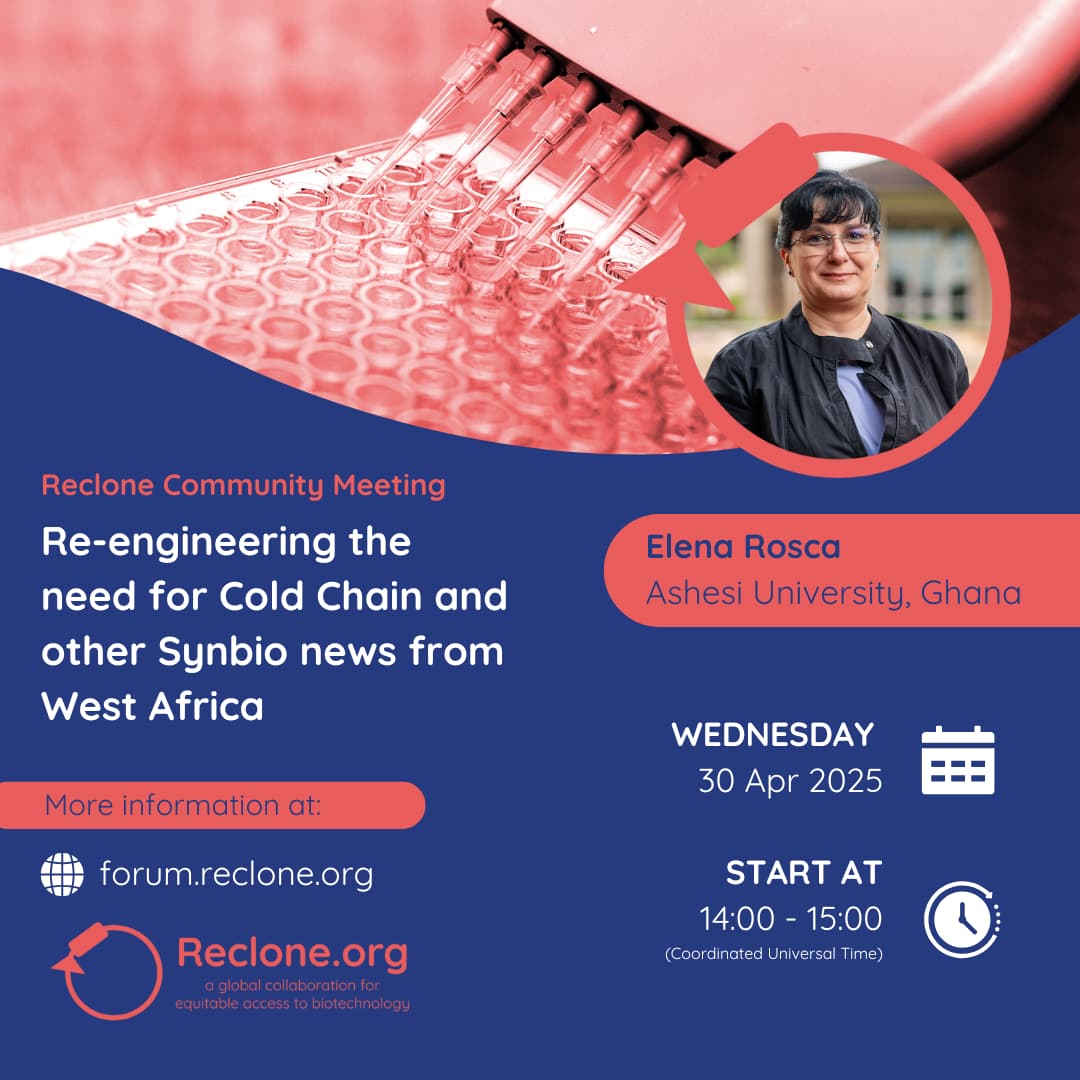
You’re all invited to our Community Meeting this month, on 2025-04-30T14:00:00Z. We will hear from @e.v.rosca presenting about “Re-engineering the need for Cold Chain and other Synbio news from West Africa”.
The Reclone network has opened a world of possibilities for the low-resource regions. However, one problem still hinders a larger reach: cold chain requirements for bacterial cell transport. We developed a simple, low-cost protocol using vacuum desiccation and trehalose to preserve E. coli BL21 and BL21(DE3) strains at room temperature. Cells remained viable and competent for transformation for up to 42 weeks. The method was validated locally and internationally, including the successful revival and transformation of cells shipped to the UK after nearly 10 months. This approach offers an accessible solution for transporting and storing bacterial cells without refrigeration. Also sharing some other news and work from the Ghana hub of SYNBIO.
Looking forward to seeing you all 2025-04-30T14:00:00Z to hear from Elena (@e.v.rosca) talk about Re-engineering the need for Cold Chain and other Synbio news from West Africa.
See the joining links in the first post above!
===
Does the need for cold chain storage and transport affect you (negatively or positively!) in your work?
Let us know in the poll and in comments below about if and how it affects you, what you usually transport, where in the world you are and to where you tend to transport things, and share with the community any ways you’ve tried to get around the need for cold chain requirements?
Does the need for cold chain storage and transport affect you (negatively or positively!) in your work?
No - we don’t transport anything
No - we would like to transport reagents, but the logistics for cold chain storage makes it prohibitive for us to do so
Yes - but we try to avoid it if we can help it as it’s a logistical nightmare
Yes - we’ve found ways around it, but it’s not ideal
Yes - so we’ve found some alternative (non-cold chain) solutions that we can share (though they might not very generalisable)
Yes - and we’ve found some tried and tested solutions that we can share
@cibele also ran a series of Open BioSharing Workshops last year that may also be of interest to the community. We took a more high-level approach for the most part, but didn’t dive too deeply into the technical challenges like cold chain issues, but the report is still be quite an interesting read!
We’re hoping to build on some of the actions from the workshops in the near future, so do keep an eye out for this news.
Thanks again for joining us for Elena Rosca’s (@e.v.rosca) inspiring talk. She is the head of the Bioengineering Department at Ashesi University in Ghana, and shared about: “Re-engineering the need for Cold Chain and other Synbio news from West Africa.”
Here were some highlights from this talk:
A frugal, cold-chain-free method for preserving bacterial cells (e.g., BL21 strains) was developed by drying them with trehalose and silica gel, maintaining viability and transformation competence for over 300 days at room temperature, enabling affordable global shipping and access in resource-limited settings.
Ashesi University in Ghana (which serves as Reclone’s African hub), produces and shares open-source enzymes (like open-vent polymerase) via dried, transformed cells, supporting local PCR, protein expression, and plans for on-campus enzyme manufacturing to boost biotech accessibility across Africa.
She showcased additional sustainable Synbio innovations, including cassava starch-based hydrogels for agricultural applications (e.g., irrigation and bacterial delivery) and a microfluidics-based lateral flow assay prototype for tuberculosis diagnostics, highlighting frugal, student-led approaches in West African bioengineering.
You can check the complete session on our YouTube: [Link]

 Join us via Zoom: Launch Meeting - Zoom

 See the joining links in the first post above!
 Does the need for cold chain storage and transport affect you (negatively or positively!) in your work?
 Reclone Community Meeting Recap
 A frugal, cold-chain-free method for preserving bacterial cells (e.g., BL21 strains) was developed by drying them with trehalose and silica gel, maintaining viability and transformation competence for over 300 days at room temperature, enabling affordable global shipping and access in resource-limited settings.